Concrete driveway building in Malden MA - a slab that drains and stays level
Cracked, sinking or puddled driveway? We dig out, pack a real base and pour a slab that sheds water away from your house.
- Fully licensed and insured.
- Free on-site estimates.
- We respond within 1 business day.
What goes into building a new concrete driveway in Malden?
The short answer: D&L Malden Concrete Company builds concrete driveways in Malden by digging out the soft ground, packing a stone base and pouring a sloped slab that carries water away from your house, so the driveway stays flat and dry through years of daily use.
Most people call us when the old driveway has cracked, sunk at one end or started holding water, and their first question is what a new one costs. The price moves with the size, whether the old concrete or asphalt has to be torn out and hauled away, how much soft ground has to come out underneath, and whether delivery trucks or a work van will use it, since heavier traffic means a thicker slab. The schedule turns on the season, the weather on pour day and the curing time before you can park on it, and the written estimate I give you after seeing the site spells out what your job involves.
How do you know your driveway needs replacing?
Cracks that keep spreading
A crack that gets wider every spring or splits into more cracks usually means the ground underneath has moved, not just the surface. Patching it buys a season or two, but the longer it goes, the more water gets in and the more of the slab breaks loose.
One section has sunk
When one slab drops below the next, the dirt under it was rarely packed well or has washed out over time. Waiting turns that lip into a trip hazard and a spot where the shovel or the plow catches every winter.
Water pools or runs toward the house
Puddles that sit for hours after rain, or a driveway that tips toward your foundation, mean the slope was set wrong or the slab has settled. That water ends up against your house or freezing on the driveway, and neither one gets better by itself.
How we handle concrete driveway building
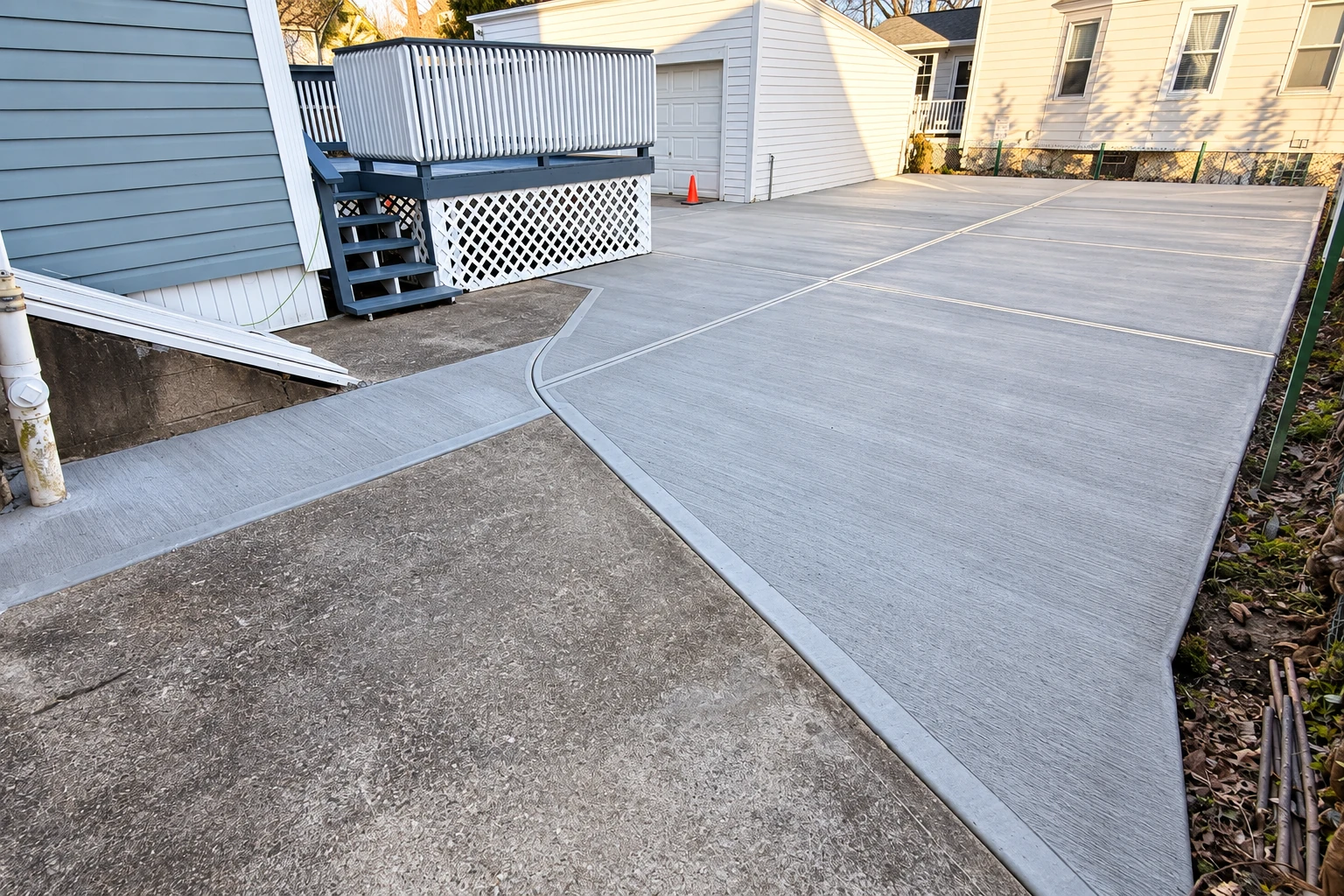
Before I price anything, I check what has to come out and which way water will run off the lot, because most driveway trouble starts underneath. Then our crew tears out the old driveway if there is one, digs out the topsoil and soft fill, and packs the subgrade, the ground the slab sits on, before laying and compacting a crushed stone base. We set the forms with a slope that sends water toward the street and away from your house, add rebar, steel bars that hold the slab together, where the traffic calls for it, and pour early in the day so the top doesn't dry out too fast in the midday heat. Once it's floated, we give it a broom finish, a light texture that gives tires and boots some grip, cut the control joints, shallow grooves that give the concrete a straight place to crack, before it can crack somewhere else, and leave it to cure, the slow hardening it needs before it takes weight. If the budget is tight, I'll talk you out of a fancier finish before I'll skimp on the base, because nobody sees the base on day one and it decides how the driveway looks ten years later.
A new driveway often leads to the rest of the yard, and we can lay out a concrete patio off the back door so both slabs drain the right way and the joints line up. If you want the driveway or a border to look like brick or stone, stamped concrete presses a pattern into the surface while it's still wet, over the same base we'd build for a plain slab.
Plain slab with a broom finish
This suits most houses with cars coming and going, because the texture grips in rain and snow and there's nothing extra to maintain. It keeps more of the budget for the digging and the base, which is where I'd put it.
Heavier slab for trucks
If delivery trucks, a work truck or a camper use the driveway, we pour it thicker and plan the steel for that weight. Tell us up front, because it changes the base, the slab and the price.
What happens when you call about a driveway in Malden?
It starts with a short call or the form, then a visit where I look at the old driveway, the ground and the drainage before anything gets priced.
- Step 01
Call or send the form
Tell us roughly how big the driveway is, whether an old one has to come out and whether trucks use it. We set a time for me to come out and see it.
- Step 02
I measure and write it up
I measure, look at where the water goes and ask how you'll use the driveway. You get a written estimate that spells out the mix, the joints, the drainage and what's included, so you know what the number covers before you decide.
- Step 03
We prep, pour and explain curing
Before anyone digs, we line up any permits, call to have underground lines marked and pick a pour date that suits the season. After the pour, we walk you through curing and first winter care so you know what to do and when.
Concrete driveway building in Malden: permits and who you hire
In Malden, the Department of Public Works issues curb cut and street opening permits, and its list names those, not driveway building, so we check with the DPW about your job before we dig. When a permit is needed, we handle the application ourselves and keep you posted on where it stands. On the hiring side, Massachusetts requires anyone who bids on or does work on an existing, owner-occupied home with one to four units to register as a Home Improvement Contractor, and you can look up a contractor's registration and history through the state before you sign. The state also offers arbitration if a job turns into a dispute, and its Guaranty Fund, a fund of last resort, pays eligible homeowners up to $25,000 when a judgment against a contractor goes unpaid.
A lot of the driveways we replace here are narrow runs beside older houses, squeezed between the foundation and the lot line, where getting the slope away from the house matters more than anything else. We work across the cities around Malden and run into the same tight lots on jobs in Everett and Medford.
Get a written estimate for your new driveway
We reply within one business day to set up a time, and I come out to measure and look at the site for a free on-site estimate, with no obligation. Mention the driveway size, whether an old one comes out and whether trucks use it, so the estimate covers all of it.
Why Malden homeowners call D&L Malden Concrete Company
I look at every job myself
I come out to see every driveway before it's priced, and our crew does the work with me on site. The person who checked your drainage and planned your joints is the same one standing there on pour day.
Working from Malden since 2017
I learned flatwork, the driveways, patios and walks that lie flat on the ground, running another contractor's crew, then went out on my own here in 2017. Nine years in, most of our jobs are in Malden and the cities around it, so we're never far from yours.
Fully licensed and insured
We're fully licensed and insured. That matters on a driveway, where the work runs from your house to the street with a concrete truck and heavy equipment on your property.
I'd rather tell you a driveway isn't worth redoing than sell you one I don't think will last, so get in touch and I'll come take a look at yours.
Concrete driveway questions from Malden homeowners
How much does a concrete driveway cost in Malden, MA?
A concrete driveway without steel reinforcement usually runs about $8 to $14 per square foot in the Boston area, not counting tearing out an old driveway. Removal, extra digging for a soft base, a thicker slab for trucks and a decorative finish all push it up. Your written estimate after the site visit puts a number on your own driveway.
How long does a concrete driveway last compared with asphalt?
With regular upkeep, a concrete driveway usually lasts 30 to 40 years and sometimes past 50, against about 15 to 30 for asphalt, according to a national comparison guide. Upkeep mostly means sealing, and industry guidelines say a penetrating sealer can go on 30 days after the pour and typically needs redoing every three to five years.
How long does it take before I can drive on a new concrete driveway?
Guidelines from a Michigan concrete industry group say a new driveway can open to cars after 7 days of curing. Plan to park on the street or somewhere else for that week, and we'll go over the timing with you on pour day.
Will my new concrete driveway crack like the old one?
No concrete can be kept from cracking entirely, but properly designed control joints steer the cracks into the joints and keep them to a minimum. That's why I lay out the joints and the slope before the first form goes in, and why the packed base matters, since a slab that settles cracks wherever it wants.
How do I protect a new concrete driveway in its first winter?
Use sand or kitty litter for traction instead of deicing salt for the first year, which is what an Ohio concrete industry group recommends. It matters most when the driveway was poured after September, so a fall job needs a salt-free plan for that first winter, and we go over it with you after the pour.
How thick should a concrete driveway be?
The Michigan guidelines call for at least 4 inches of concrete, and at least 5 inches when delivery vehicles will use the driveway. Tell us if trucks, a camper or regular deliveries come up your driveway, because that changes the thickness and the steel we plan for.
Related concrete work for your yard
Concrete patio construction
A patio poured around the same time as your driveway can share one drainage plan, so water from both slabs heads away from the house together.
Stamped concrete services
If a plain gray driveway feels too plain for the front of your house, a stamped pattern gives the look of brick or stone over a solid base.
Plan your new concrete driveway with us
Call (781) 288-8155 or use the form, and if you have photos of the cracks or the puddles, mention them when we talk so I know what to look for on the visit.