
Concrete patio construction in Malden MA - a slab that sheds water away from your house
Cracked, sinking or puddled patio by the back door? We build a new slab that drains away from the house and holds up to winter.
- Fully licensed and insured.
- Free on-site estimates.
- We respond within 1 business day.
What does it take to build a concrete patio in Malden?
The short answer: Concrete patio construction in Malden means digging out the yard, packing a solid base and pouring an outdoor slab that rain runs off instead of soaking into, sloped so the water heads away from your house.
Most people who call us have an old patio that's cracked, tipped or holding puddles by the back door, or a patch of yard they're tired of mowing around. We're based in Malden and work across the cities around it, including Everett, Medford, Melrose and Somerville. The price mostly moves with the size of the patio, how much old concrete and dirt has to come out, whether the slab needs steel in it and the finish you pick, while the schedule turns on permits, getting underground lines marked, a pour date that suits the weather and the curing time before you use it. If the patio meets a back door with a drop, we can build new concrete steps at the same time. Your own figure comes from the written estimate once I've seen the yard.
How do you know your patio needs replacing?
Water sitting by the house
If rain puddles on the patio or runs toward your back wall, the slab usually falls toward the house instead of away from it, often because it settled after it was poured. Every storm then sends water at your foundation, and in winter those puddles freeze right where you walk.
Cracks in random places
Cracks that wander across the slab instead of following the cut lines usually mean the joints were cut late, laid out wrong or skipped. Once they open, water gets in, and each freeze pushes them a little wider until the edges start breaking off.
One side has sunk
A patio that tilts, rocks or has a corner lower than the rest usually sits on a base that was raked level instead of dug out and packed, so it settled with the dirt. Left alone it keeps dropping, and the step down from the door gets bigger and easier to trip on.
How we handle concrete patio construction
I start by setting the slope and the joint layout before a single form goes in, and I show you both, because a patio this close to the house has to carry water away from the foundation. Then we dig out and pack a stone base in layers so the subgrade, what the slab actually sits on, won't settle later the way raked-in dirt does. We set the forms to that slope, add rebar where the slab needs it, which is steel inside the concrete that holds it together if it does crack, and pour early in the day so the top doesn't dry too fast in the afternoon heat and turn weak and dusty. After finishing, we cut control joints, shallow grooves that give the slab a planned place to crack, while the concrete is still fresh enough for them to do their job, then leave it to cure, the wait that lets it gain strength before it takes weight. If the budget is tight, I'd rather keep the money in the base and go plain on the surface, because the base is hidden on day one and it's the first thing people want to cut, but it's what decides whether the patio is still flat years from now.
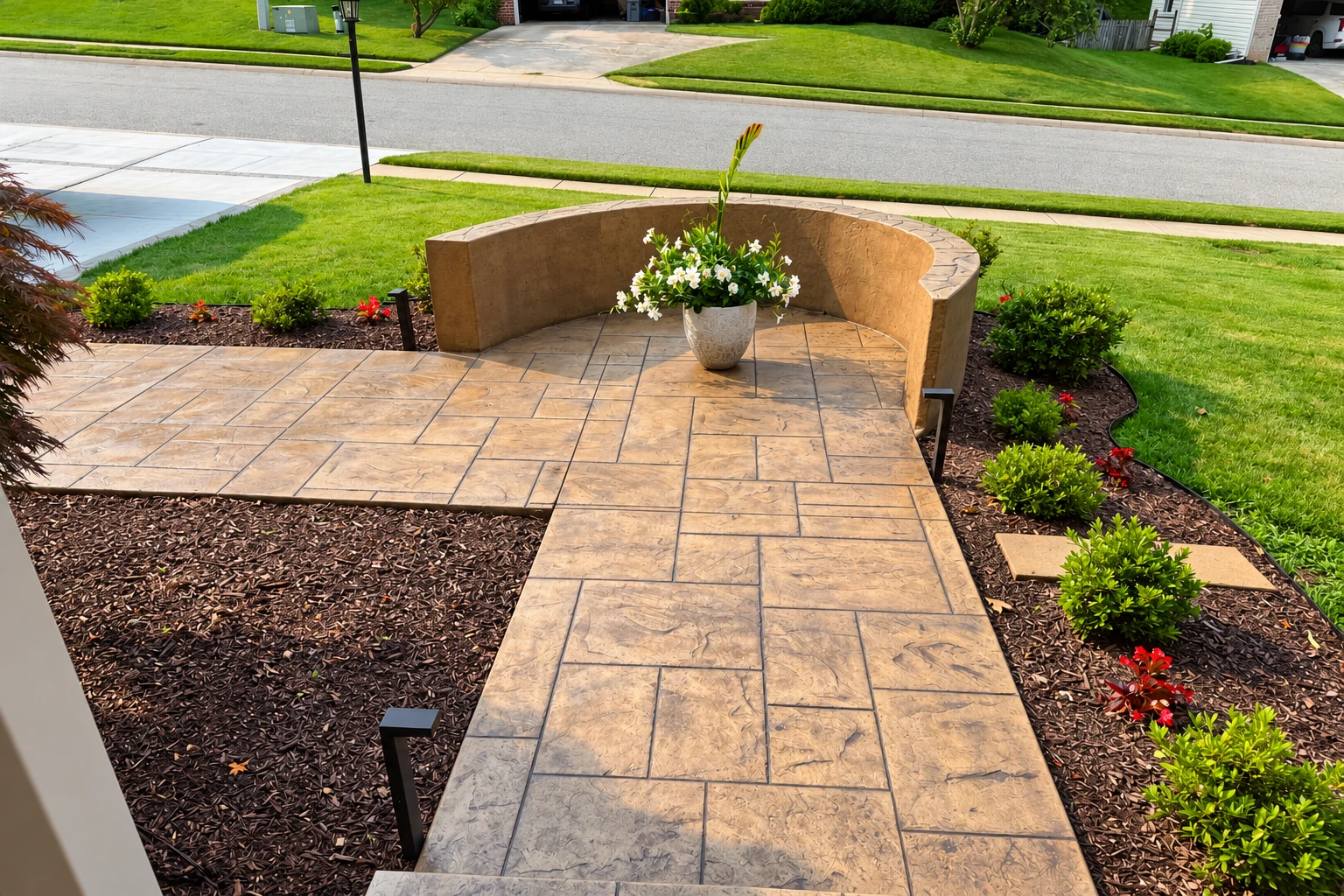
A lot of patio jobs grow by one piece. If you'd like the surface to look like stone or brick, we can pour it as stamped concrete, and if you need a way to reach the patio from the driveway or the gate, a concrete sidewalk poured on the same slope plan keeps everything draining in the same direction.
Broom-finished slab
This is the plain, everyday patio, textured by dragging a broom across the wet surface so it isn't slick when it's wet or icy. It suits most families and most budgets, and it puts the money where I'd put it, into the base.
Stamped or colored surface
This suits a patio that's the centerpiece of the yard, where you want the look of stone or brick without loose pavers. It costs more and takes more crew time on pour day, so I'd only go this way once the base and slope are covered.
What happens after you call us about a patio?
From the first call to the day you can use the patio, the job runs in four steps, and you'll know what's coming before anything happens in your yard.
- Step 01
We come out and measure
Call or send the form and I'll set a time to come look at the yard, measure the space and ask how you'll use it. A grill and a dining table need a different size and shape than a spot for two chairs.
- Step 02
You get a written estimate
The estimate spells out the concrete mix, the joint layout, the drainage and what's included, so there's no guessing about what you're paying for. You can lay it next to anyone else's and see what each one covers.
- Step 03
We prep, dig and pour
Before anyone digs or pours, we line up any permits, call to have underground lines marked and pick a pour date that suits the season. Then we dig out, pack the base, set the forms and pour.
- Step 04
We walk you through curing
After the pour we go over curing and first winter care with you. You'll know when to walk on it, when to put weight on it and what to keep off it.
Building a concrete patio in Malden
In Malden, permits go through Malden Inspectional Services, and whether your patio needs one is something we check with the city before we plan the dig, not something we assume. When a job needs a permit, we handle the application ourselves and keep you posted on where it stands, and you can also look it up and check its status yourself through the city's online permitting system.
Many of the backyards we work in here are small and tight to the house, with a narrow side yard between neighbors, so the patio sits right up against the foundation and a truck can't always get close. That's why slope gets so much of our attention, and why we plan how the concrete goes in and the dirt comes out before pour day, the same as on jobs in Medford and Everett.
Get a written estimate for your new patio
Send the form and we'll reply within one business day to set a time for me to come out, measure and talk through how you'll use the space. The on-site estimate is free, with no pressure and no obligation, and having the patio's rough size in square feet handy helps us talk it through.
Why Malden homeowners call D&L Malden Concrete Company
I look at every job myself
I come out to see every job myself, and our crew does the work with me on site. The person who planned your slope is the one standing there when the forms go in.
Running our own crew since 2017
Before going out on my own in 2017, I was another contractor's right hand, running his crew, ordering the mix and laying out jobs. That's where the habit of planning slope and joints before anything gets formed comes from.
Fully licensed and insured in Massachusetts
We're fully licensed and insured, and for work on an existing owner-occupied home with one to four units, the state requires contractors to be registered as a Home Improvement Contractor, which is separate from a Construction Supervisor License. That registration matters to you because the state's Home Improvement Contractor program takes complaints, runs arbitration for disputes and can pay eligible homeowners up to $25,000 from its Guaranty Fund for unpaid judgments against contractors.
On any patio bid, look hardest at the base and the slope, because you can't check either once the concrete is down. When you're ready, get in touch or call (781) 288-8155 and I'll come take a look.
Concrete patio questions from Malden homeowners
How much does a concrete patio cost in Malden, MA?
A concrete patio in the Boston area usually costs about $6 to $15 per square foot, including materials and labor. That's the going rate in the area, not our price, and it doesn't include stamping or staining. Measure the space you have in mind and you'll have a rough idea before I come out.
Will a new concrete patio crack like my old one?
It may get a crack or two, because nobody can stop concrete from cracking entirely, but properly designed joints control where cracks happen and keep them small. Wire mesh won't stop cracking either, though it tends to keep cracks and joints from opening up, so it's worth seeing whether a bid includes it. When you're comparing contractors, ask each one to show you their joint plan.
How long does a new concrete patio take before you can walk on it?
You can usually walk on a new slab within 48 hours, according to one Boston cost guide. The same guide suggests waiting a week before putting heavier loads on it, and says concrete takes a month to fully cure.
How do I protect a new concrete patio in its first winter?
Keep deicing salts and chemicals off it the first winter, even when the surface looks hard, because new outdoor concrete needs time to cure before it faces hard freezes or deicers. Concrete that's soaked with water can be damaged by freezing over and over, which is why air-entrained concrete, a mix with tiny, evenly spread air pockets that give freezing water room, is a key way to make a slab last where the weather calls for it.
Which way should a concrete patio slope next to my house?
It should slope down and away from the house. National building guidance says patio slabs within 10 feet of the foundation should slope away from it, and you can ask any contractor which way the finished slab will slope before work begins.
Who calls Dig Safe before digging a patio in Massachusetts?
Your contractor does, because when a contractor is doing the work, holding a valid Dig Safe ticket is their job, and you can call for them but don't have to. State law requires contacting Dig Safe at least 72 business hours before any digging, not counting Saturdays, Sundays or holidays, and it counts grading, backfilling and demolition as digging too.
Concrete work that pairs with a new patio
Stamped concrete services
Stamped concrete gives a patio the pattern of slate, brick or stone in one solid slab, with no loose pavers to shift or weeds in the gaps.
Concrete sidewalk building
A new walk from the driveway or front gate gives the patio a clean, level way in, so guests aren't crossing wet grass to reach it.
Call (781) 288-8155 to plan your patio
Pour dates follow the season and the weather, so the earlier I've seen your yard, the more say you have in when the concrete goes in.